Athens
CHAPTER PREFACE:
A CHARACTER’S ACCOUNT OF ATHENS
“My first taste of Athens a few years ago was with a view of the Acropolis at a rooftop restaurant, a visit to ancient sites, and some light exploration of islands.
I remember Athens had this energy to it, this openness and friendliness, and steeped in so much culture. The delicious souvlaki, saganaki with honey, a mix of Mediterranean delights. Seafood reminiscent of Italy and Croatia, but filo dough, feta, and yogurt divinely inherent to Greece. Not to mention the olive oil.
There was so much rich literature to draw on, the Greeks’ connection to the sea. Athens is one of the oldest cities in Europe, and its architecture and history preserved in so many great ways.”
ON THE WALL:
(ACTUAL BOOK TEXT)
Fortune
Homer said: “Nothing happens by chance: everything follows the divine order of fate.”
Plato said: “Since the world has come into being, its cause must be for good.”
I say, good fortune brought you here reading these words with the Acropolis behind you.
Destiny’s eloquence is in this moment.
Unknown tomorrows save us from known yesterdays.
And today, every small decision participates in the world’s story.
A blink of your eye, bigger than the sky.
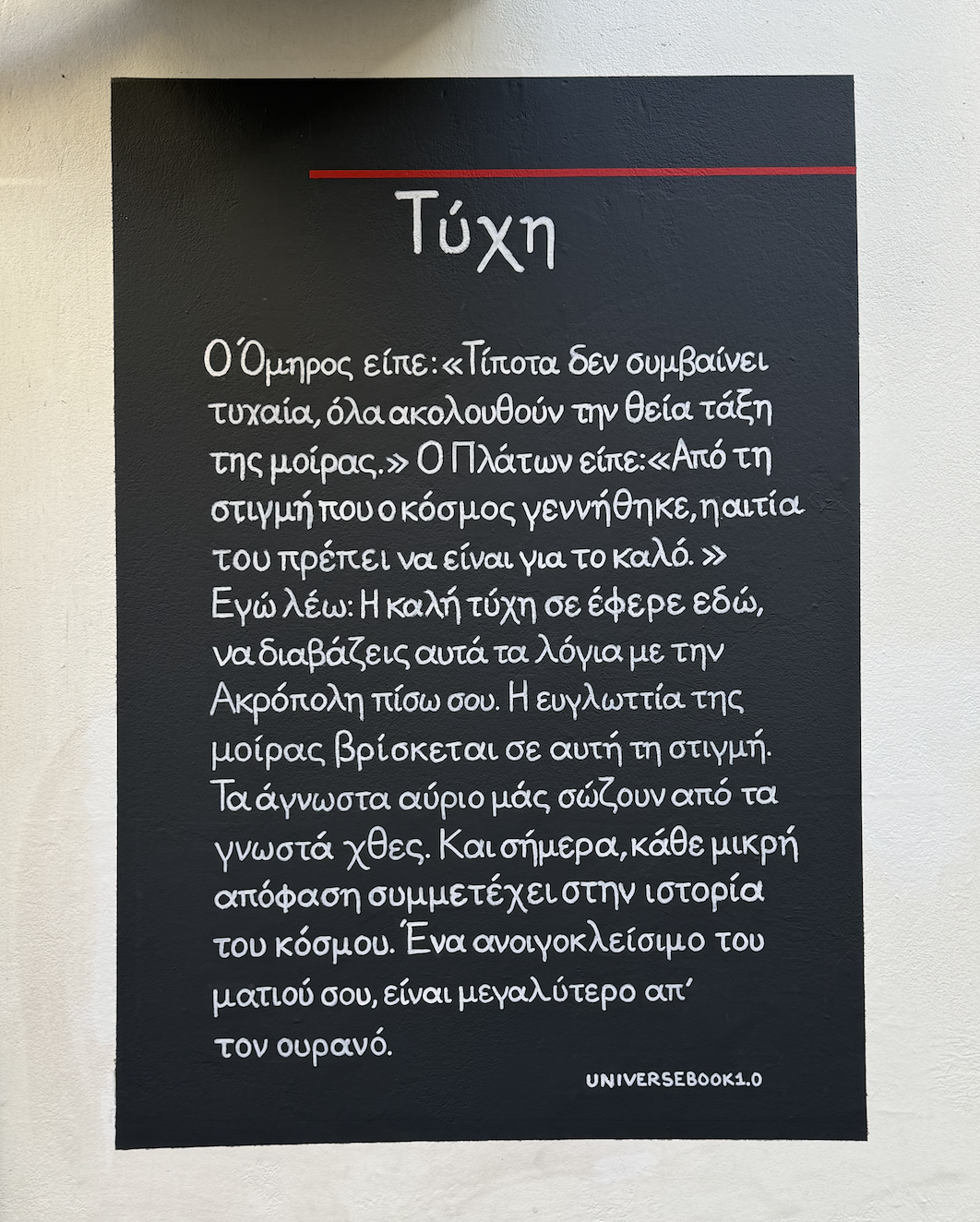
Τύχη
Ο Όμηρος είπε: «Τίποτα δεν συμβαίνει τυχαία, όλα ακολουθούν την θεία τάξη της μοίρας.»
Ο Πλάτων είπε: «Από τη στιγμή που ο κόσμος γεννήθηκε, η αιτία του πρέπει να είναι για το καλό.»
Εγώ λέω: Η καλή τύχη σε έφερε εδώ, να διαβάζεις αυτά τα λόγια με την Ακρόπολη πίσω σου.
Η ευγλωττία της μοίρας βρίσκεται σε αυτή τη στιγμή.
Τα άγνωστα αύριο μάς σώζουν από τα γνωστά χθες.
Και σήμερα, κάθε μικρή απόφαση συμμετέχει στην ιστορία του κόσμου.
Ένα ανοιγοκλείσιμο του ματιού σου, είναι μεγαλύτερο απ’ τον ουρανό.
BEHIND THE TEXT
This piece was inspired by the Greek classics. This bookstore holds the largest collection of translated Greek classics, a volume of 12,000.
Greek literature has influenced the world with its philosophers, Gods and myths.
Τύχη (Tyche) is the Greek goddess of fortune and protector of the city. This piece bestow this good fortune to the city, located in the bustling neighborhood of Monastiraki, with a view of the Acropolis.
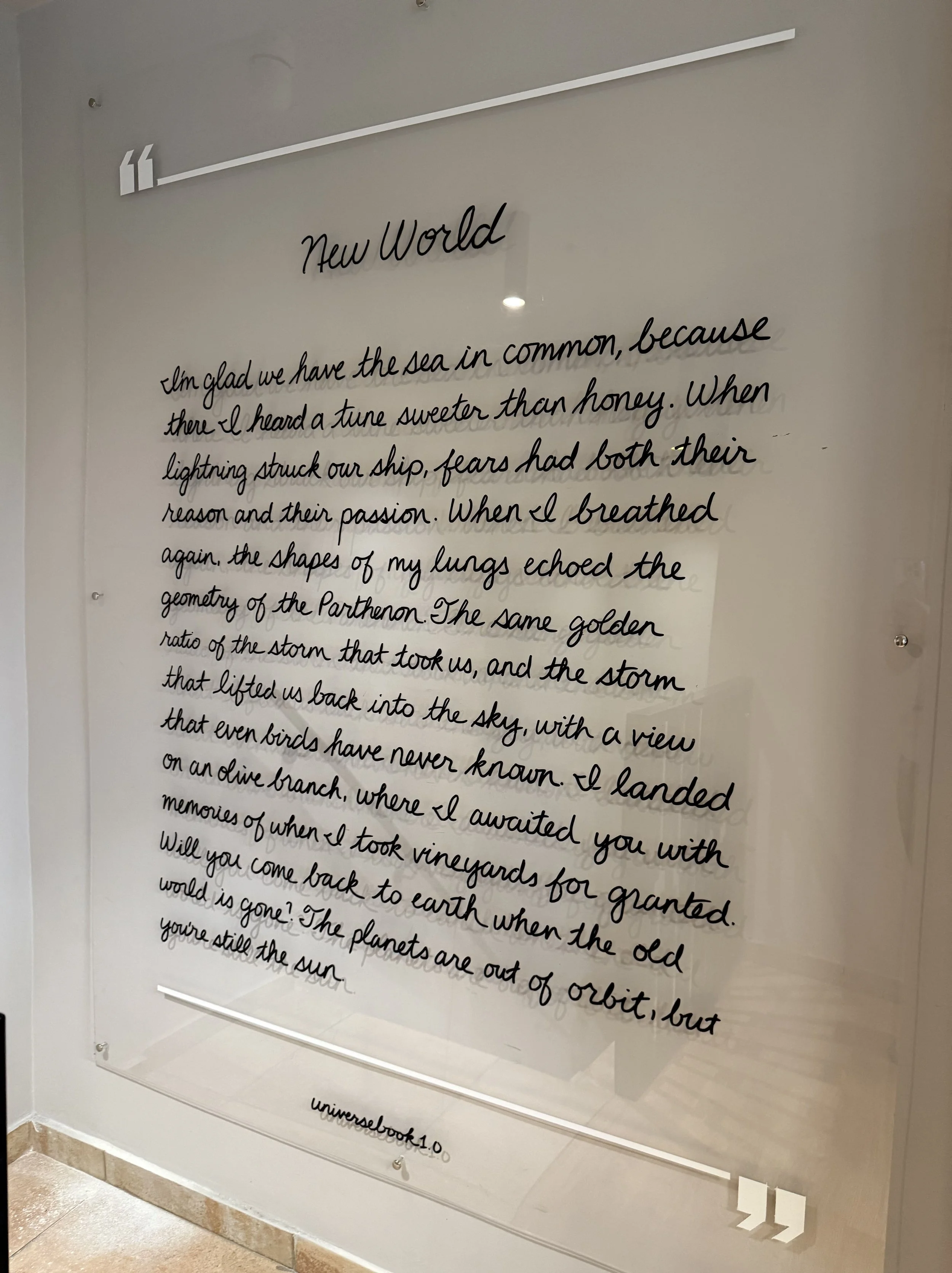
New World
I’m glad we have the sea in common, because there I heard a tune sweeter than honey. When lightning struck our ship, fears had both their reason and their passion.
When I breathed again, the shapes of my lungs echoed the geometry of the Parthenon.
The same golden ratio of the storm that took us, and the storm that lifted us back into the sky, with a view that even birds have never known.
I landed on an olive branch, where I awaited you with memories of when I took vineyards for granted.
Will you come back to earth when the old world is gone? The planets are out of orbit, but you’re still the sun.
BEHIND THE TEXT
This was inspired by the Greek Nobel laureate poet Odysseas Elytis who said, “If you deconstruct Greece, you will in the end see an olive tree, a grapevine, and a boat remain. That is, with as much, you reconstruct her.”
This tells a lot about Greek identity. But it was also inspired by the neighborhood Neos Kosmos, which means “New World.”
The story in the beginning references the Greek myth about Odysseus and the sea monster Charybdis, who would swallow the sea and then spit it back up hours later. In the myth, Odysseus is saved by a fig tree.
The Parthenon is also one of the pinnacles of architecture using the golden ratio (1.618), many gold rectangles in the columns, providing harmony.
The Fibonacci ratio numbers approach the golden ratio as the numbers go up, 𝜙. Fibonacci occurs in nature, in shells, in sunflowers, even in the womb. For me, Fibonacci is an essential part of life. Human lungs (through the asymmetrical branching of the bronchi) follows the fractal rules of the Fibonacci sequence.