Lisbon
CHAPTER PREFACE:
A CHARACTER’S ACCOUNT OF LISBON
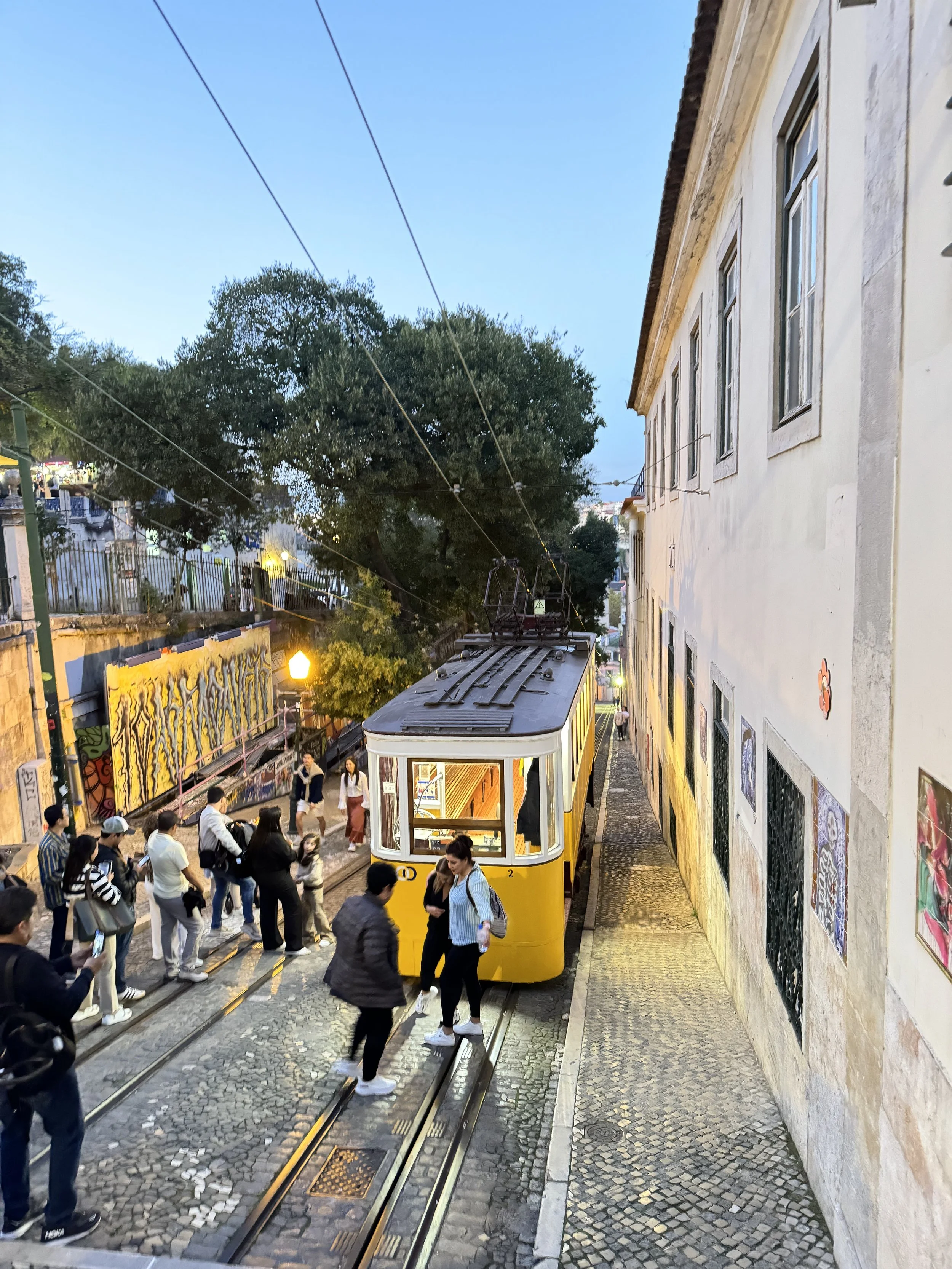
“Lisbon is like a fun 3D maze. It’s called the ‘city of seven hills.’ It’s very hilly, and certain roads will connect in interesting ways. It’s right on the Tagus River (Tejo), and it’s easy to drive to nearby Cascais (also on the water), Cabo da Roca (western most part of Europe), and Sintra, known for its palaces (with Freemason history) and beautiful mansions.
Lisbon itself is pretty big, but the city center is compressed. There are lots of lookout points where you can see the stunning architecture (orange roofs against the backdrop of the blue water). There’s also a Moorish castle in the middle of town.
Lisbon is filled to the brim with art. Outdoor raves, Berlin-style parties, and festivals in the forests are common as well. Lisbon is super diverse, and hosts an alternative crowd.
Bairro Alto is a famous area downtown, where you can eat traditional Portuguese fare (francesinha, sardines, tremoços). The seafood there is insane. It’s fun to listen to traditional Fado music or traverse the famous Pink Street. The old town of Alfama definitely worth a peek, along with the churches, incredible to see. Some of my favorite memories of Lisbon are the street festivals with people cooking sardines and dancing outside.
Another fun part of the culture is to drink a Ginjinha at a kiosk, a little station in many parks serving drinks and small bites. A big part of the culture is to eat and drink on the street after work.
Surfing is also accessible just outside of Lisbon, but you need a wetsuit. Atlantic currents and winds are generally rougher there, but it’s nice for kitesurfing.
Azulejos, or tiles, are a big part of the culture and history. They fortify the buildings, make them stronger. You see tiles everywhere! On the outside of buildings, on the inside of buildings as decorative borders, inside train stations, inside metro stations, and on the sides of bridges—beautiful mosaics or amazing large scale images depicting Portuguese history and Moorish designs.”
ON THE WALL:
(ACTUAL BOOK TEXT)
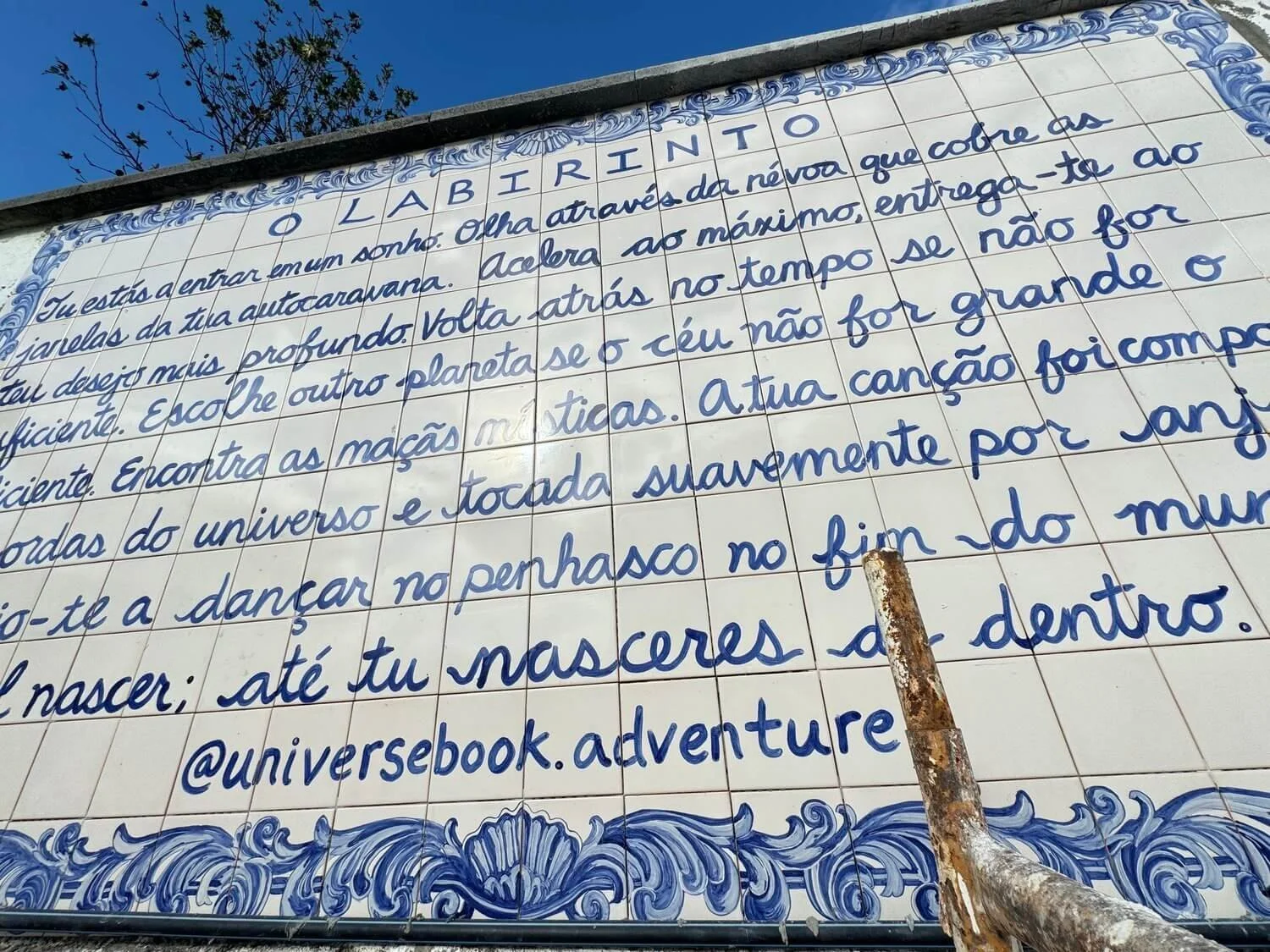
The Labyrinth
You are entering a dream. Look through the fog covering the windows of your van. Throttle at your desires full speed, indulge your deepest wish. Turn back time if there’s not enough. Pick another planet if the sky isn’t big enough. Find the mystical apples. Your song was composed on the strings of the universe and strummed gently by angels. I see you dancing on the cliff at the end of the world. Until the sun rises. Until within, you rise.
BEHIND THE TEXT
This wall, tiled at Fabrica Braco de Prata, is written to the reader. It is instructions to enter a dream, or a portal into another world. Lisbon is a maze of sorts, and in the book, you are now entering the maze. You must find the exit in another city. While in the maze, you should solve the clues and complete the mission to find the exit. Right across the parking lot is famous Portuguese artist Vhils’ work, a pair of eyes. It’s as if they’re reading the piece.
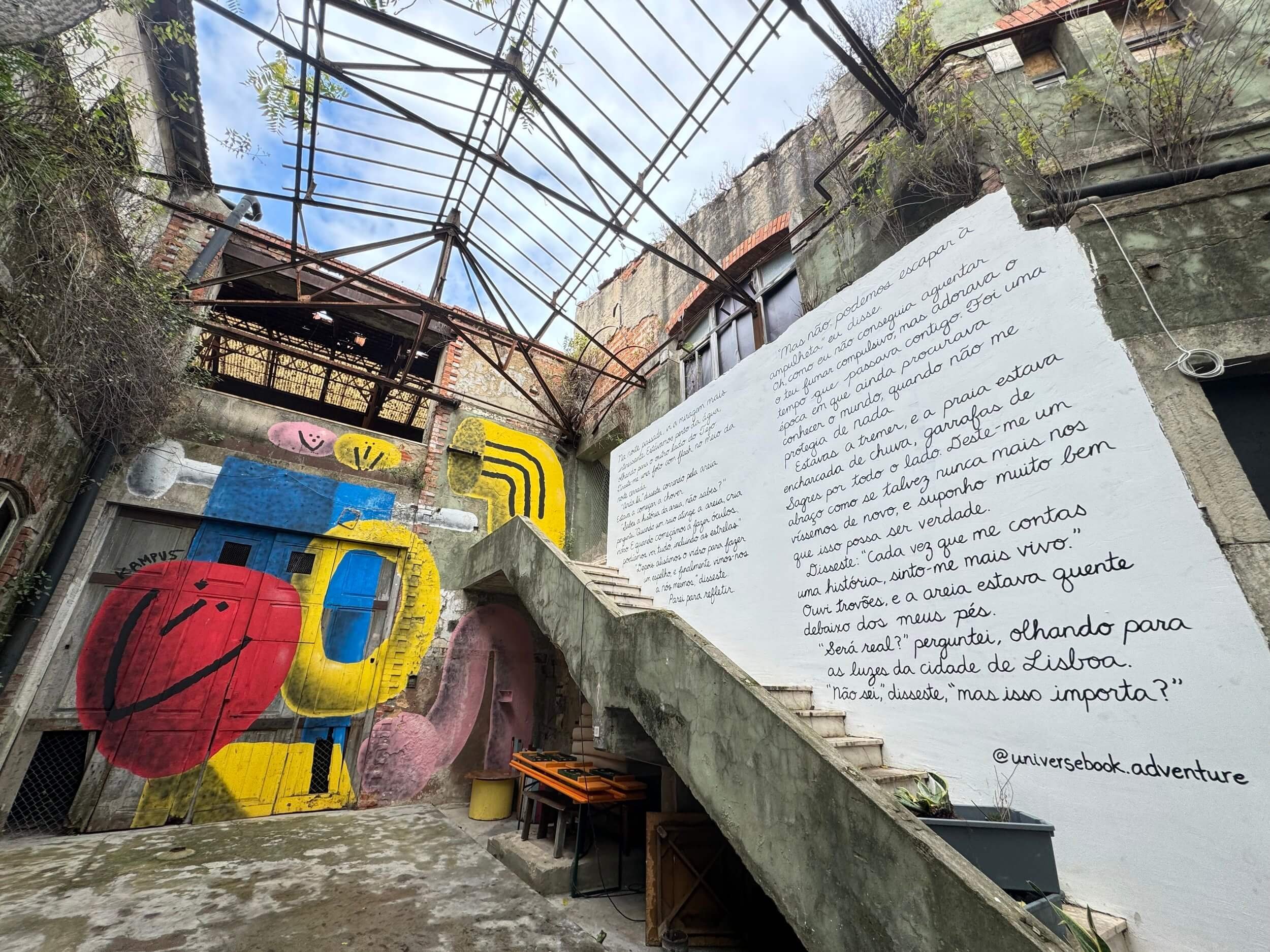
The Mirage
Last night, I saw the most interesting mirage.
We were near the water, looking across the Tejo. You took a photo of me with flash in the dead of night.
“Come on,” you said, running across the sand.
It was starting to rain.
“You know the story about sand, right?” I said. “When lightning strikes sand, it creates glass. And once we made eyeglasses, we could see everything, including the moon and the stars.”
“Then we smoothed out the glass to make a mirror, and we finally saw ourselves,” you said.
I paused to reflect.
“But we can’t escape the hourglass,” I said.
Oh how I couldn’t stand your chainsmoking but I loved the time spent with you.
It was a time when I still sought to know the world, when I protected myself from nothing.
You were shivering, and the beach was soaked with rain, Sagres bottles everywhere. You gave me a hug like we might never see each other again, and I suppose very well that could be true.
You said, “every time you tell me a story I feel more alive.”
I heard thunder, and the sand was warm under my feet.
“Is this real?” I asked, looking at Lisbon’s city lights.
“I don’t know,” you said, “but does it matter?”
BEHIND THE TEXT
This wall was painted at Mirari.
It was inspired by true events, a night that the main character is at the beach with friends (including you, the reader).
You should figure out here if you’ve exited the maze yet, or if you’re still in the dream.