Pai
CHAPTER PREFACE
A CHARACTER’S ACCOUNT OF PAI:
“Pai is a hippie town located in northern Thailand in Mae Hong Son province. It’s about 3 hours by car from Chiang Mai, and you go up a very windy road up a mountain to reach Pai.
It’s the kind of town where everyone knows everyone. It’s easy to run into someone on Walking Street (a popular main road in town surrounded by hotels, restaurants, massage parlors). There’s also a a night market every night filled with street food vendors.
There’s also a park and surrounding businesses including restaurants, bakery, cafes, and yoga studio that hosts a Saturday Market, and everyone in town goes for street food and buying clothes/crafts. During the Saturday Market, you’ll see pretty much everyone in town including families and kids playing in the park, jamming (drum circles, kirtans). Some of my good friends are in their 50s and 60s, and on Saturday market everyone comes out to play together. My favorite part is that people are really present and in touch with themselves and nature.
Flow arts is really popular. It’s a big circus, fire dancing, acrobatics, movement and dance community. There’s an abundance of hippie activities, like handpan festivals where they bring in digideridoos, tibetan bowls, and other sound healing instruments. There are also regular ecstatic dances, yoga classes, singing circles, breathwork sessions, plant medicine and other healing modalities. it’s basically a hippie wonderland.
My friends in town perform in fire shows or are musicians who play in bands in town pretty regularly—so I can see live music almost every day. There’s a big artistic community, I read some poetry of my own on open mic nights. It’s a really nice space to collaborate.
The whole ambiance of the town reminds me of hippie musicians from the 60s. People are really open and accepting and chill, not that much emphasis on working or routine or stressing, people just go with the flow and share their food and have tea. Not as much of a drinking culture unless it’s tourists, people are pretty conscious.
There’s a lot of gorgeous nature, most people get around by motorbike, and there aren’t that many cars in town which is nice. It’s a really common thing to go to a waterfall hike or go to the hot springs pretty much any day of the week. Anywhere you look there’s beautiful forests. There are also beautiful hot springs all around, it’s fun to go hot spring hopping at sunset.
I would say the best part though is the community, any time I’m out I’ll run into like 10 people I know. People are very present, super friendly, eager to help each other, giving, inclusive, and in touch with nature. I love getting to know the locals and go back to regular spots—a lot of them serve healthy food, lots of vegan options, LOTS of fruit, tea leaf salads, summer rolls, mango and sticky rice, and other Thai delicacies.
Thailand also has a Buddhist culture, 90% of Thais are Theravāda Buddhists. There is a big buddha statue in town, and you can see it walking down the main streets or near the river. Pai really has everything, people have even compared it to a Utopia.”
ON THE WALL:
(ACTUAL BOOK TEXT)
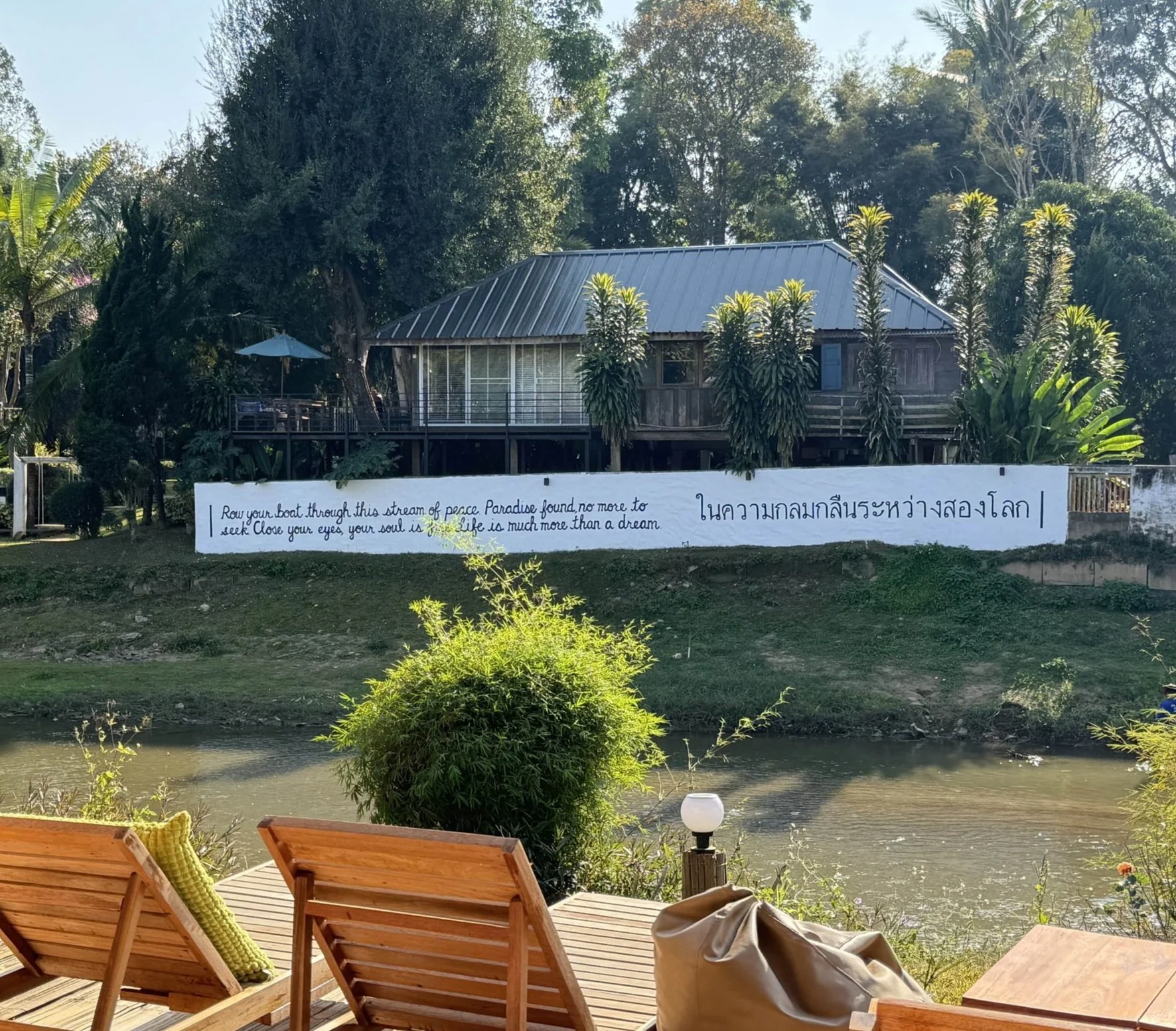
In Harmony
Row your boat through this stream of peace.
Paradise found, no more to seek.
Close your eyes, your soul is free.
Life is much more than a dream.
ในความกลมกลืนระหว่างสองโลก
Translation of Thai words:
In harmony between two worlds
BEHIND THE TEXT:
Stylistically, it resembles a block quote.
This piece is a remix of Row, Row, Row Your Boat, a popular English nursery rhyme. It’s also located right along the Pai River and can be best seen from the Pai sling bamboo bridge, a foot bridge which charmingly wobbles upon crossing.
Another ritual activity in Pai is Tipsy Tubing. Tubers read this wall as they float down the river, their journey culminating in a party in nature.
The idea that “life is but a dream” is a spiritual one, that life is an illusion (In vedic texts / Hindu/Buddhist traditions this is spoken of as maya, the illusory world).
This piece flips the verse to pose a philosophical question on the enigma of life.
Since it’s best seen from the river and the bridge, the Thai words “in harmony between two worlds” speaks to this theme of bridging two worlds.
When you’re standing on a bridge, you’re neither here nor there, you’re in between places. Similarly, on the river, you’re neither here nor there, but everywhere, always flowing, and also between two worlds. This line speaks to harmony between two sides, any kind of opposing forces, yin and yang, duality.
Bridges are a recurring theme in the novel, because they connect two spaces that were previously separated. (See Budapest and Porto chapters).
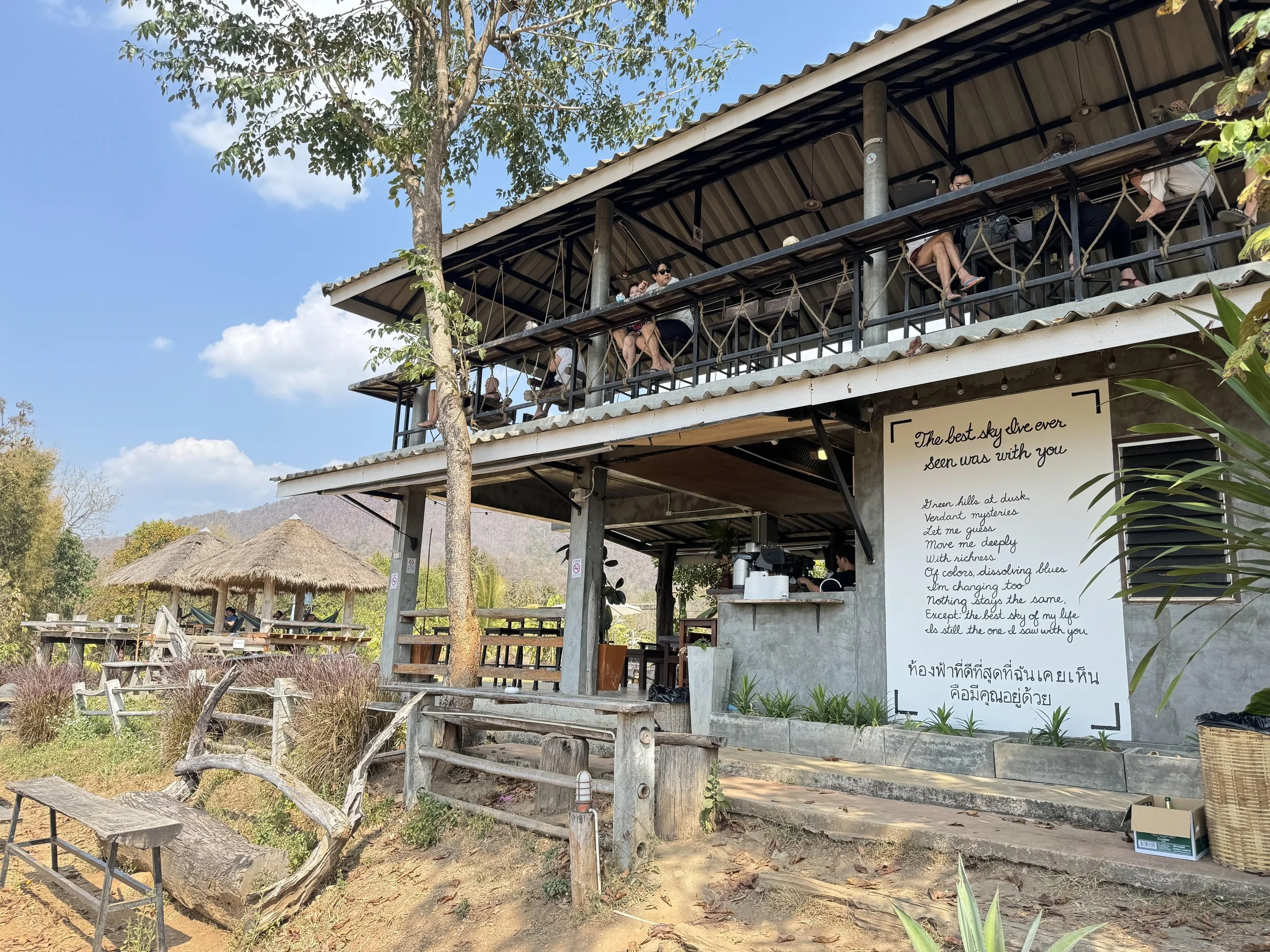
The Best Sky I’ve Ever Seen Was With You
Green hills at dusk,
Verdant mysteries
Let me guess
Move me deeply
With richness
Of colors, dissolving blues
I’m changing too
Nothing stays the same,
Except: the best sky of my life
Is still the one I saw with you
ท้องฟ้าที่ดีที่สุดที่ฉันเคยเห็น
คือมีคุณอยู่ด้วย
Translation of Thai words: The best sky I’ve ever seen was with you
BEHIND THE TEXT:
xx
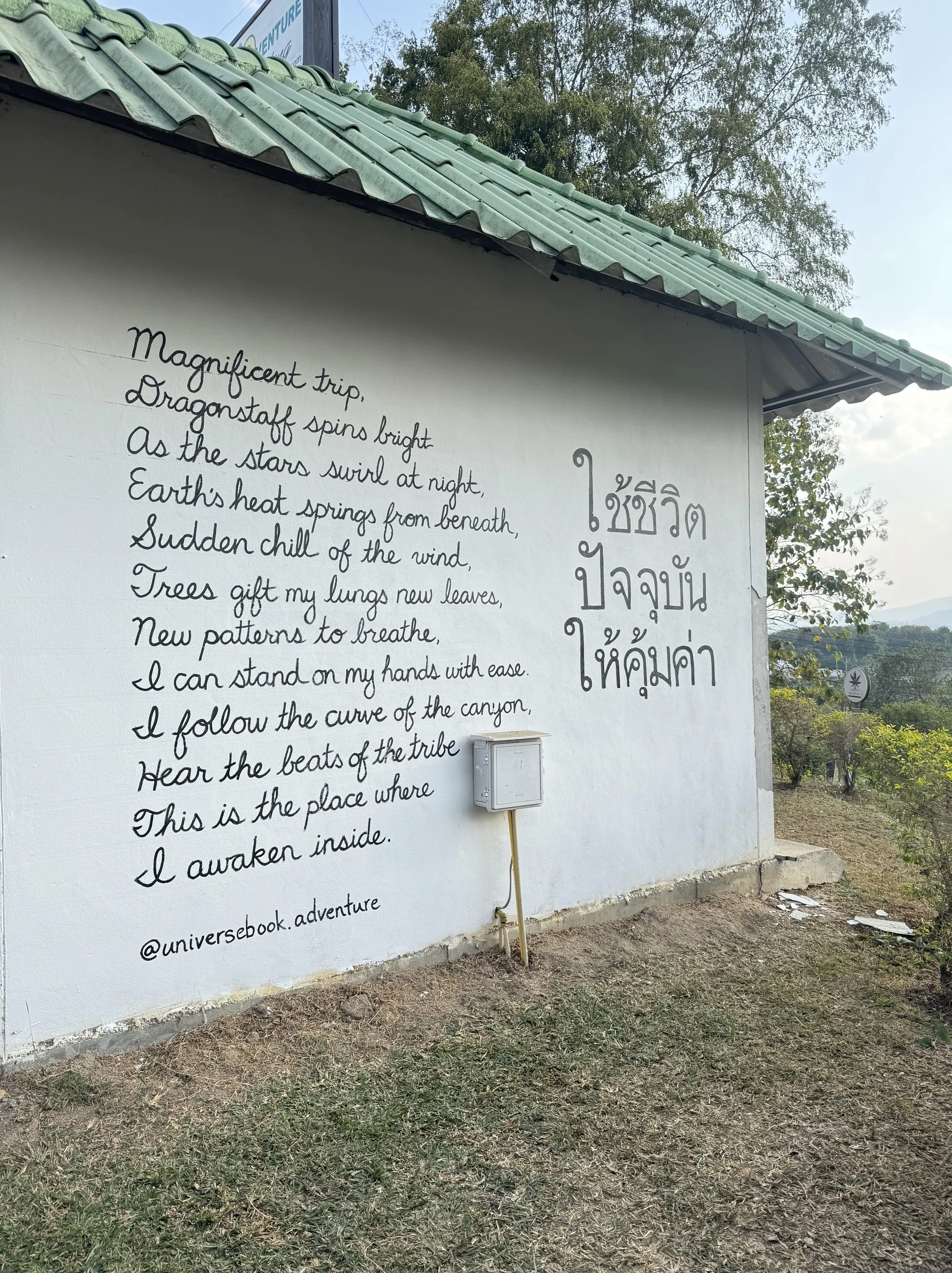
Magnificent trip,
Dragonstaff spins bright
As the stars swirl at night
Earth’s heat springs from beneath
Sudden chill of the wind,
Trees gift my lungs new leaves,
New patterns to breathe
I can stand on my hands with ease
I follow the curve of the canyon,
Hear the beats of the tribe,
This is the place where
I awaken inside
ใช้ชีวิต
ปัจจุบัน
ให้คุ้มค่า
Translation of Thai words: Make the present life worthwhile.
BEHIND THE TEXT:
xx